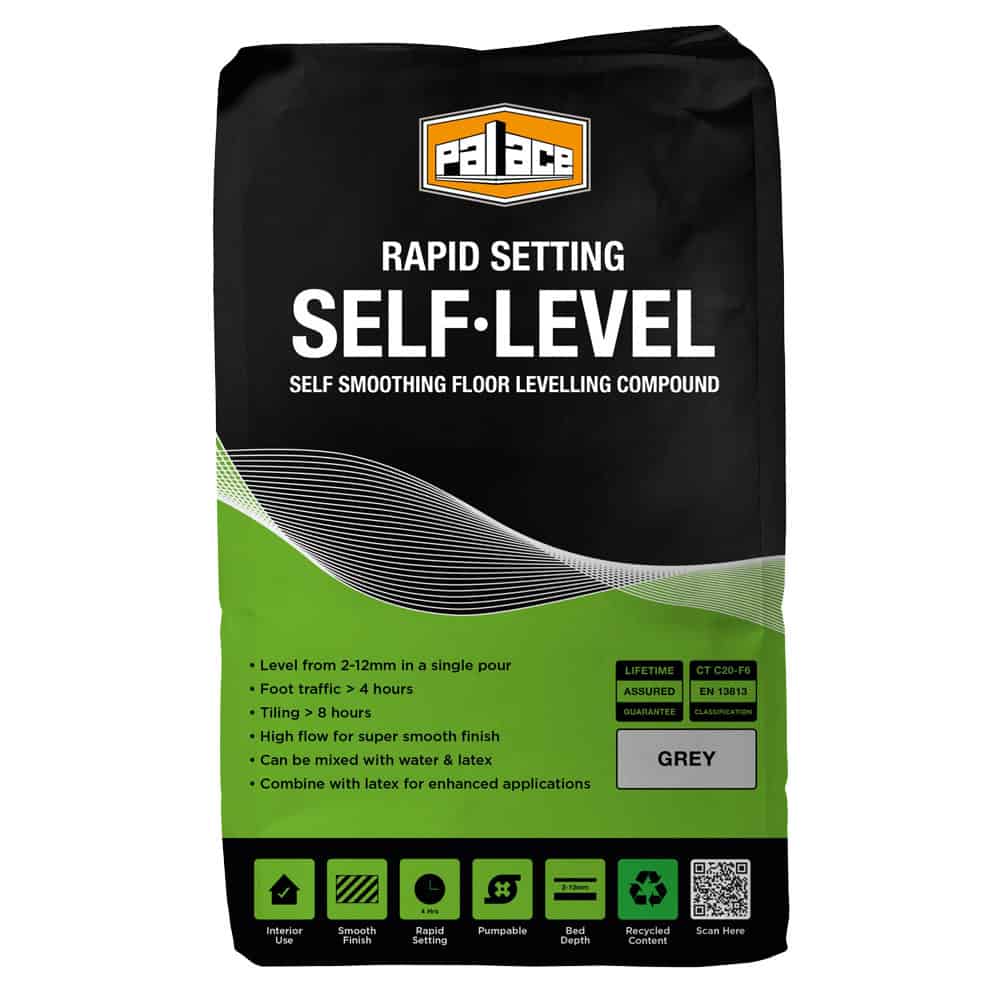

Self-Level Floor Compound 2mm-12mm – 20kg
Self-Level Floor Compound 2mm-12mm – 20kg is a rapid-setting, cement-based smoothing underlayment designed to create a consistently flat and even surface before tiles or decorative floor coverings are installed. Its high-flow formulation helps correct minor variations in solid subfloors, leaving a smooth base that is suitable for the next stage of the flooring project.
Manufactured by Palace Chemicals, this professional floor compound contains carefully blended cements, finely graded sands and organic superplasticisers. When mixed with the correct quantity of water or Palace Self-Level Latex, it forms a fluid and workable compound that can be applied from 2mm to 12mm thick in a single pour.
The product is protein-free, ammonia-free and low odour, making it suitable for use in occupied domestic and commercial properties when normal ventilation and safety precautions are observed. It is intended for interior floor preparation and must be covered with a suitable final floor finish.
Creates a Smooth and Level Subfloor
Uneven floors can cause problems when installing tiles, vinyl, laminate, carpet or other decorative coverings. Raised areas, shallow depressions and changes in the surface can affect the appearance and durability of the completed floor. Palace Self-Level provides a smooth intermediate layer that helps create the consistently level base needed for professional results.
The compound’s high-flow characteristics make it easy to distribute across the floor using a suitable smoothing trowel or levelling tool. Once poured and spread, it settles to produce a fine, smooth finish with minimal effort. A spiked roller can be used while the compound remains fluid to release trapped air and help adjoining pours blend together.
Suitable Application Depth
Self-Level can be laid at depths between 2mm and 12mm in a single application. This makes it suitable for correcting minor variations and general surface irregularities across concrete floors and cement-based screeds.
Deeper isolated areas of up to approximately 25mm may be filled when the product is bulked out using clean, dry coarse sand in the proportion specified by Palace Chemicals. However, this changes the flow and finish of the material. Any deep repairs should be completed and allowed to firm before applying the final smoothing layer.
The product should not be used to correct structural movement, unstable backgrounds or major differences in floor height. Any cracks, movement joints, damaged screeds or serious substrate defects must be properly assessed and repaired before application.
Suitable Subfloors
When mixed with clean water, Palace Self-Level is primarily intended for solid, absorbent masonry backgrounds such as tamped concrete, worn concrete and sand/cement floor screeds. The receiving surface must be structurally sound, stable and capable of supporting the final flooring system.
For non-porous or more demanding backgrounds—including flooring-grade asphalt, suitable plywood, dense concrete, firmly bonded existing tiles and painted or sealed floors—the powder should be mixed with Palace Self-Level Latex instead of water. The latex additive improves flexibility and adhesion to these less absorbent surfaces.
The latex mixture should also be used where suitable under-tile heating is installed. Always confirm that the background, heating system and intended floor covering are compatible with the complete installation system.
Surface Preparation
Correct preparation is essential. The floor must be hard, sound and free from dust, grease, oil, floor polish, laitance, plaster, loose paint and other contamination that could prevent a secure bond. Weak surface material and poorly adhered coatings must be mechanically removed before the floor is thoroughly vacuumed.
Any existing adhesive or coating residue must be strong, firmly bonded and unaffected by moisture. Soft, loose, water-soluble or moisture-sensitive residues should be completely removed.
Porous surfaces should be primed with a suitable product such as Palace Multi-Prime, diluted according to the manufacturer’s instructions. Priming helps control suction, reduces the risk of pinholes and extends the compound’s flow time.
Anhydrite or calcium sulphate screeds require specific preparation. They must be fully dry, mechanically abraded to remove surface laitance and treated with the specified coats of Palace Multi-Prime. This creates a separating barrier between the gypsum-based screed and the cement-based leveller.
Checking for Moisture
Concrete and sand/cement screeds must be sufficiently dry before the compound and final floor covering are installed. Moisture testing is particularly important when fitting moisture-sensitive materials such as vinyl, timber or certain flooring adhesives.
If an effective structural damp-proof membrane is not present, or the moisture level is above the accepted limit for the intended covering, a suitable surface-applied damp-proof membrane may be required. Palace 1-Coat DPM can be used as part of an appropriate preparation system when installed in accordance with its technical instructions.
Mixing Instructions
Pour approximately 4.4 to 4.6 litres of clean water into a clean mixing bucket. Gradually add the entire 20kg bag while mixing continuously with a slow-speed electric drill fitted with a suitable paddle. Mix for at least two minutes after all the powder has been added, producing a smooth, creamy and lump-free consistency.
For non-porous surfaces, suitable plywood or heated subfloors, replace the water with one complete 5-litre bottle of Palace Self-Level Latex. Do not combine the full quantity of water and latex, and do not exceed the recommended liquid ratio.
Once mixed, pour the compound onto the prepared floor and spread it immediately. The material remains workable for approximately 20 to 30 minutes at 20°C, so the area, tools and materials should be prepared before mixing begins. Never add extra water after the product starts to set.
Drying and Curing Times
Under suitable conditions, the floor can normally accept light foot traffic after approximately four hours. Ceramic tiles can generally be installed after around eight hours when the compound has been applied at a typical depth.
These times are approximate. Low temperatures, high humidity, limited airflow and thicker applications will extend the drying period. Always ensure the compound is fully dry and suitable for the selected covering before continuing.
Coverage
One 20kg bag covers approximately 4m² when applied at a depth of 3mm over a smooth, even and non-absorbent surface. Actual coverage will depend on the condition of the floor, application depth and normal installation waste. Uneven or textured floors will require more material.
Key Features and Benefits
- Rapid-setting cement-based floor compound
- Suitable for depths from 2mm to 12mm
- High-flow formulation for a smooth finish
- Approximately 4m² coverage at 3mm depth
- Walkable after approximately four hours
- Ready for tiling after approximately eight hours
- Can be mixed with water or Palace Self-Level Latex
- Suitable for concrete and sand/cement screeds
- Suitable for selected non-porous surfaces when mixed with latex
- Can be used with suitable underfloor heating when mixed with latex
- Protein-free, ammonia-free and low odour
- 20kg trade-size bag
Storage and Safety
Store the unopened bag in a cool, dry location, raised clear of the ground and protected from moisture. As the product contains cement, the wet mixture is alkaline. Wear gloves, protective clothing and eye protection, and avoid breathing dust while mixing. Always consult the latest Palace Chemicals technical and safety data sheets before use.