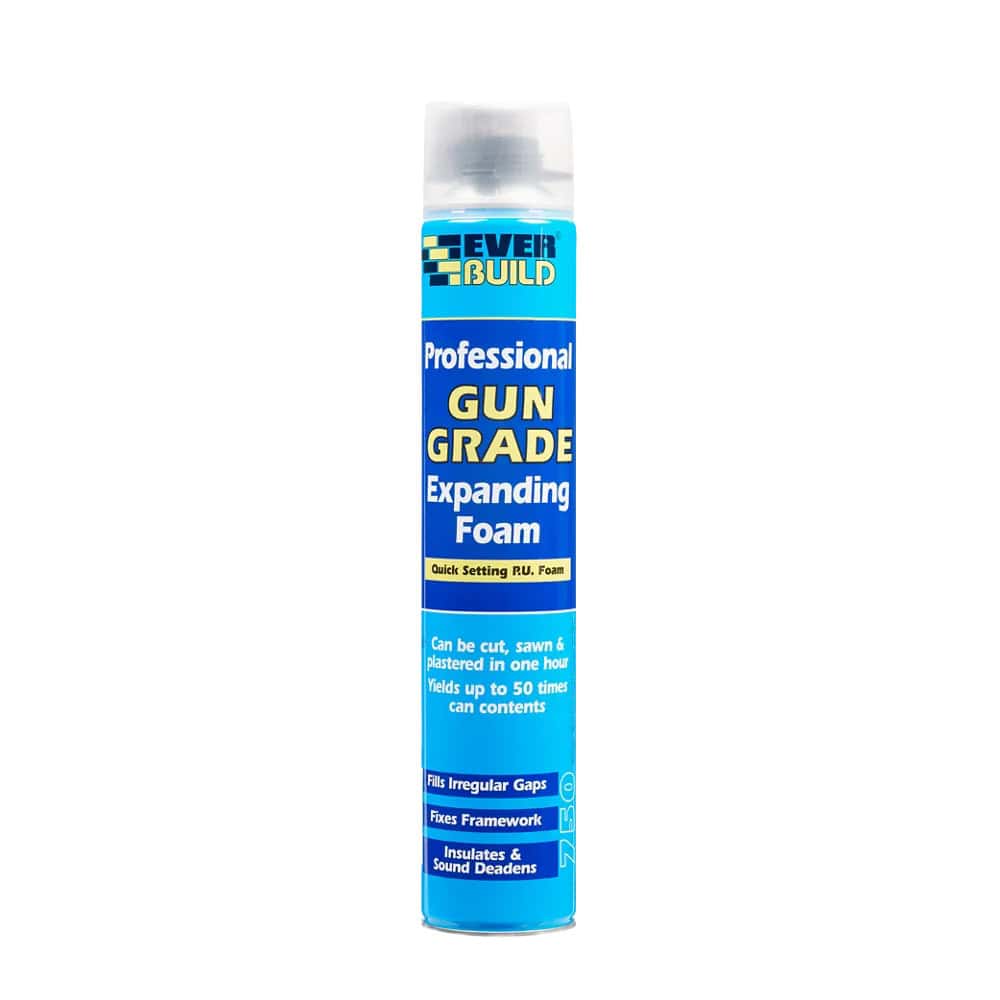

Everbuild Gun Grade Expanding Foam 750ml
Everbuild Gun Grade Expanding Foam 750ml is a professional, quick-setting polyurethane foam designed for controlled application using a compatible expanding-foam gun. It expands after application to fill broad, deep and irregular gaps where traditional solid fillers may be difficult to apply.
The gun-grade format provides greater control over the flow and position of the foam than a standard handheld aerosol. This makes it particularly useful for tradespeople who need to apply consistent beads, work in confined spaces or complete several filling and insulation tasks from the same can.
Once cured, the foam can be cut, sawn, sanded or plastered over to create a neat finish. It also offers useful thermal-insulating and sound-deadening properties, making it suitable for filling gaps around building components and reducing unwanted air or sound movement through cavities.
Professional Gun-Controlled Application
Everbuild Gun Grade Expanding Foam is designed to be attached directly to a suitable professional foam applicator gun. The gun allows the user to regulate the rate of flow and place the product more accurately than with a basic straw applicator.
Controlled dispensing is particularly valuable around window and door frames, where excessive expansion could cause unnecessary mess or place pressure on surrounding components. The applicator can also help reach narrow, deep or awkward areas while reducing product waste.
The gun can remain attached between applications when stored in accordance with the manufacturer’s instructions. If the can is removed, the gun and valve should be cleaned immediately using a compatible Everbuild foam cleaner before any remaining foam cures.
Filling Applications
The expanding action makes this product suitable for filling cavities and uneven gaps that conventional fillers may not reach effectively. Common filling applications include:
- Gaps around window frames
- Gaps around door frames
- Openings around pipes passing through walls
- Electrical wire chases before plastering
- Deep joints before applying sealant or plaster
- Irregular gaps in brick, stone, concrete and plaster
- Voids between construction materials
- Hard-to-reach cavities requiring an expanding fill
The cavity should only be partially filled because the foam expands after leaving the gun. Applying too much material can result in excessive waste and may place unwanted pressure on lightweight frames, trims or panels.
Fixing and Supporting
Everbuild Gun Grade Expanding Foam can also assist with fixing and supporting suitable building components. Typical uses include installing door frames, window frames, windowsills, thresholds and lightweight timber structures.
Foam should not be treated as a substitute for required structural or mechanical fixings. Door and window frames must be supported and braced until the product is fully cured, and permanent fixings should be installed wherever required by the component manufacturer, building regulations or project specification.
Thermal and Acoustic Insulation
Once cured, the foam’s cellular structure helps reduce heat transfer and limit the passage of sound through gaps and cavities. It can be used behind exterior wall cladding, soffits and bargeboards, as well as around frames and service entries.
A continuous, well-filled application will provide better insulating performance than a thin or interrupted bead. Care should be taken to avoid hidden voids, particularly when filling wide or deep spaces. Large cavities may need to be filled in stages so that each section can cure properly.
Yield and Setting Time
One 750ml can can produce up to approximately 45 litres of expanded foam under suitable conditions. Actual yield will vary depending on temperature, humidity, applicator setting, joint dimensions and application technique.
The product becomes tack-free in approximately eight minutes under typical conditions. It can generally be cut, sawn or plastered over after around 20 minutes to one hour, depending on the dimensions of the foam bead and the working environment.
A 20mm bead may require approximately 12 hours to achieve full load-bearing stability. Deeper or larger applications can take longer to cure, particularly in cold or dry environments. A firm outer surface does not necessarily mean that the centre of a deep application has cured completely.
Surface Preparation
All surfaces should be clean, sound and free from dust, grease, oil and loose material. Remove unstable particles and protect nearby decorative surfaces against accidental splashes or expansion.
Lightly moisten the application area with clean water before dispensing the foam. Polyurethane foam cures through contact with moisture, so light dampening can improve expansion and cell structure. Do not leave standing water inside the cavity.
When filling a deep gap in layers, lightly misting between applications can assist curing. Allow each layer sufficient space to expand before applying additional material.
How to Apply Everbuild Gun Grade Expanding Foam
- Read the product label and safety data before beginning work.
- Wear suitable protective gloves, eye protection and work clothing.
- Make sure the application area has adequate ventilation.
- Clean the surfaces and remove all loose or contaminated material.
- Lightly moisten the cavity with clean water.
- Shake the can vigorously approximately 20 times.
- Remove the protective cap and carefully screw the can onto a compatible foam gun.
- Do not overtighten the can onto the gun adapter.
- Hold the can upside down during application.
- Adjust the gun to produce a controlled and manageable flow.
- Partially fill the cavity, leaving sufficient room for expansion.
- Allow the foam to cure before trimming, cutting or covering it.
- Clean the gun and valve with a compatible foam cleaner after use.
Apply the product carefully and avoid overfilling. Test the gun setting on a disposable surface before beginning precise work, especially when using a newly attached can.
Finishing and Protecting the Foam
After curing, unwanted material can be cut back using a suitable knife or saw. The surface may then be sanded, plastered or covered with a compatible sealant or decorative finish.
Cured polyurethane foam should be protected from prolonged exposure to ultraviolet light. Exterior applications should be covered with a suitable paint, sealant, plaster, trim or other protective material. Always confirm compatibility before applying a coating.
Wet foam can be removed using Everbuild Dual Purpose Foam Cleaner. Once cured, it can only be removed mechanically, so surrounding areas should be protected before application.
Temperature Performance
The cured foam has a stated long-term service-temperature range of approximately -40°C to +80°C and a short-term range of approximately -40°C to +100°C. The recommended application temperature is above +5°C, with conditions around 20°C providing the best performance.
Cold cans or surfaces can reduce yield and increase curing time. Do not heat the pressurised container using direct heat, flame or hot water.
Important Fire Classification
Everbuild Gun Grade Expanding Foam has a B3 reaction-to-fire classification under DIN 4102-1. It is not a fire-rated foam and must not be used where a specified fire-resistant or fire-stopping product is required. For fire-rated joints and service penetrations, select a tested Everbuild fire foam system suitable for the required configuration.
Safety and Storage
The can is pressurised and contains a flammable polyurethane formulation. Keep it away from heat, sparks, open flames and other ignition sources. Use only in well-ventilated areas and avoid breathing vapours or spray.
Store the can upright between approximately +5°C and +25°C, away from direct sunlight. Do not expose it to temperatures above 50°C, and never pierce or burn the container, even after use. Keep out of the reach of children.
Efficient Filling, Fixing and Insulation
Everbuild Gun Grade Expanding Foam 750ml provides the accuracy and control needed for professional filling and insulation work. Its rapid curing, high yield and ability to fill difficult gaps make it ideal for frames, pipe entries, deep joints and irregular cavities. When applied with a compatible foam gun, it offers precise dispensing, reduced waste and a clean, manageable finish across numerous building and maintenance applications.