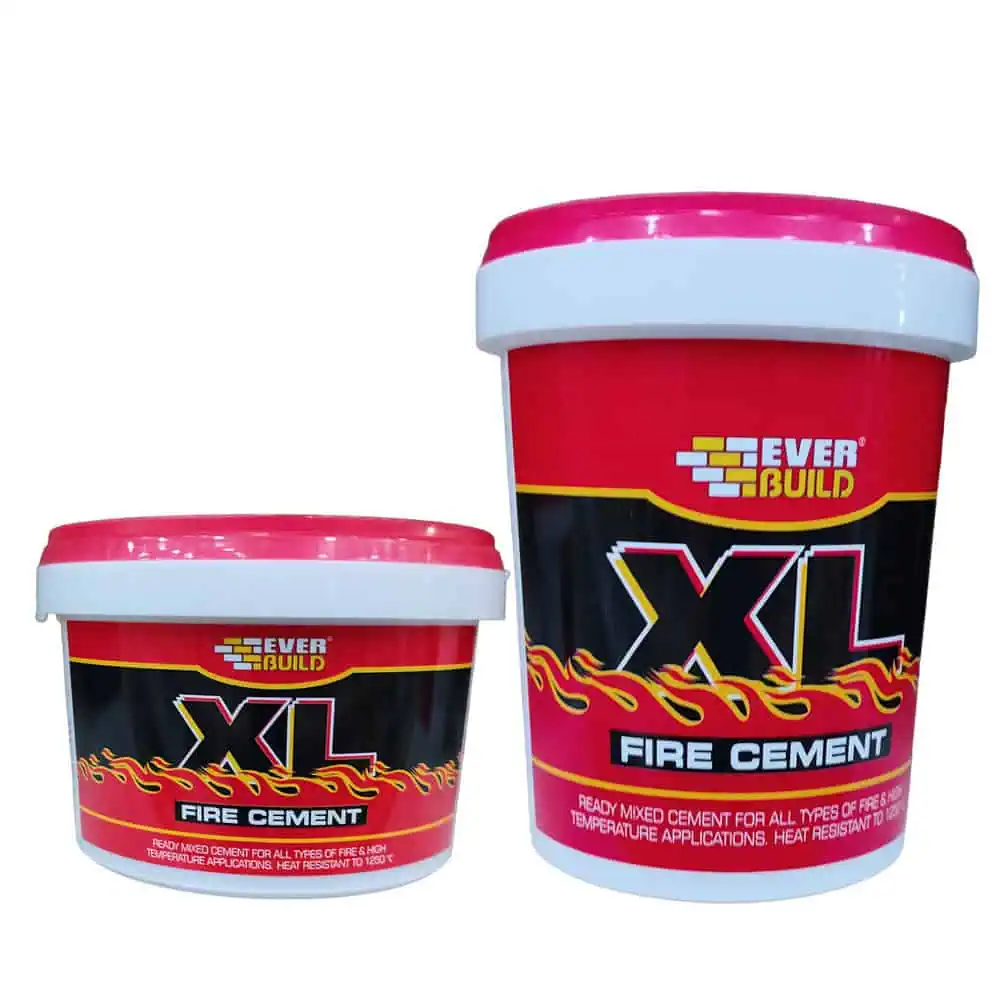

Everbuild XL Fire Cement
Everbuild XL Fire Cement is a ready-mixed, high-temperature cement for repairing and sealing joints in fireplaces, solid-fuel stoves, fire bricks, fire grates, flue pipes, boilers and other areas exposed to extreme heat. Manufactured from a blend of thermosetting resins and inorganic fillers, it cures when exposed to heat and forms a heat-resistant mortar capable of withstanding service temperatures up to 1250°C.
Its thick, ready-to-use consistency eliminates the need to measure and mix a traditional dry fire cement. The material can be applied directly from the tub using a suitable trowel or pointing tool, making it a practical solution for domestic heating repairs, stove installations and commercial or industrial maintenance.
Everbuild XL Fire Cement provides excellent adhesion to fire bricks, blockwork, natural stone and clayware. Once correctly cured, it can help form a smoke-tight seal around compatible components exposed to high operating temperatures.
High-Temperature Resistance
Standard mortars, fillers and sealants are not designed to withstand the temperatures produced by fires, stoves and heating appliances. Exposure to intense heat can cause ordinary products to crack, soften, burn or lose adhesion.
Everbuild XL Fire Cement is specifically formulated for high-temperature applications. After heat curing, it can withstand service temperatures ranging from approximately -10°C to +1250°C. This makes it suitable for use around many domestic and commercial solid-fuel appliances where the repaired area will be directly exposed to heat.
The product’s suitability must still be checked against the appliance manufacturer’s instructions. Some modern stoves, boilers, flue systems and specialist appliances require approved components or proprietary sealing products to maintain their certification, warranty or tested performance.
Typical Applications
Everbuild XL Fire Cement can be used for a variety of high-temperature sealing and repair tasks, including:
- Repairing joints between fire bricks
- Sealing around fire grates
- Jointing suitable flue pipes and flue bricks
- Repairs around domestic fireplaces
- Sealing suitable areas of solid-fuel stoves
- Repairs to boilers and heating appliances
- High-temperature joints in stone and clayware
- Domestic, commercial and selected industrial applications
It is particularly useful for filling small cracks, gaps and joints within rigid heat-resistant structures. The cement should only be applied to stable surfaces and must not be relied upon to secure loose, unsupported or structurally unsafe appliance components.
Damaged fire bricks, corroded flue pipes and defective stove or boiler parts may require replacement rather than surface repair. Where the safety or condition of an appliance is uncertain, the work should be inspected and completed by a suitably qualified professional.
Ready-Mixed for Convenient Application
Everbuild XL Fire Cement is supplied as a thick grey paste and is ready to use directly from the tub. There is no need to combine separate powders and liquids, which helps simplify preparation and reduces the risk of producing an inconsistent mixture.
Stir or work the product as necessary before application. If the cement is too firm to apply, it can be softened using a small amount of clean water. Add water sparingly, as excessive dilution may affect its consistency and performance.
Only remove the quantity required, and close the tub promptly to prevent the remaining material from drying. Do not return used or contaminated cement to the original container.
Surface Preparation
The surfaces must be sound, stable and suitable for exposure to high temperatures. Remove soot, ash, dust, grease, loose mortar and other contaminants that could reduce adhesion.
Old or failed fire cement should be carefully removed until a solid edge and clean background are exposed. A wire brush or other suitable hand tool may be used, taking care not to damage fire bricks, flue components or the appliance.
The joint should provide enough depth and surface area for the cement to form an effective repair. Very thin surface smears are more likely to crack or detach than material properly worked into a prepared joint.
Ensure the appliance is completely cool and not in operation before starting. Do not apply fire cement to hot surfaces.
How to Apply Everbuild XL Fire Cement
Apply the cement directly from the tub using a trowel, filling knife or suitable pointing tool. Work the material firmly into the joint to eliminate gaps and achieve complete contact with the sides of the repair.
Finish the exposed surface neatly before the cement begins to stiffen. Remove excess material using the application tool and clean surrounding areas promptly.
Approximate consumption is three linear metres per kilogram when applying a 15mm bead. Actual coverage will depend on the width, depth and shape of the joint, the condition of the substrate and the amount of material needed to fill the repair completely.
Heat-Curing Process
Everbuild XL Fire Cement cures when it is exposed to heat. After application, heat must be introduced gradually over a period of approximately four hours. Raising the temperature slowly allows moisture to escape and helps reduce the risk of excessive cracking.
Do not immediately operate the appliance at its maximum temperature. Begin with a low heat and increase it progressively throughout the curing period, following the instructions supplied with the cement and the heating appliance.
Small cracks may develop during initial heat curing as moisture leaves the material. These should be made good using fresh Everbuild XL Fire Cement to help create a smoke-tight seal.
The appliance should not be treated as fully repaired until the cement has been correctly heat cured and the joints have been inspected. If significant or recurring cracks develop, allow the appliance to cool and investigate the cause before further use.
Important Limitations
Fire cement creates a hard, rigid repair and is not suitable for joints that are expected to experience significant movement. Thermal expansion between different materials may cause cracking where movement cannot be accommodated.
It should not be used as a general-purpose building cement, flexible sealant or structural adhesive. It must not be used as a substitute for approved fire-stopping products in compartment walls, floors or other passive fire-protection systems.
Everbuild XL Fire Cement is designed to resist high temperatures, but this does not mean that every repair made with it achieves a specific fire-resistance period. Where building regulations or a certified fire rating apply, use the complete tested and approved system specified for the project.
Key Benefits
- Ready-mixed high-temperature fire cement
- Resistant to temperatures up to 1250°C
- Cures when gradually exposed to heat
- Suitable for fireplaces and solid-fuel stoves
- Ideal for fire bricks, fire grates and flue pipes
- Suitable for boilers and other heating applications
- Excellent adhesion to fire brick and blockwork
- Adheres to stone and clayware
- Easy to apply with a trowel
- Suitable for domestic and industrial applications
- Asbestos-free formulation
- Available in several convenient tub sizes
Product Information
- Brand: Everbuild
- Product: XL Fire Cement
- Product type: Ready-mixed heat-curing cement
- Appearance: Thick paste
- Colour: Grey
- Application method: Trowel or pointing tool
- Maximum service temperature: 1250°C
- Service temperature range: Approximately -10°C to +1250°C
- Application temperature: Approximately +5°C to +60°C
- Approximate consumption: 3m per kg based on a 15mm bead
- Available sizes: 500g, 1kg, 2kg and 5kg
- Shelf life: Up to 12 months when correctly stored
- Formulation: Asbestos free
Cleaning, Storage and Safety
Clean tools immediately after use with warm water and soap. Once cured, the material may need to be removed mechanically.
Store the product in its original container at moderate temperatures between +5°C and +30°C. Keep the tub sealed and away from direct sunlight.
Wear suitable protective gloves and eye protection during use. The product can cause serious eye damage, so avoid splashes and wash contaminated skin promptly.
Always read the product label and the latest safety and technical data sheets before application. Heating appliances, flues and solid-fuel systems should be installed, maintained and repaired by a competent professional where required.