
How To Remove Efflorescence from Patios & Paving
White patches appearing on the surface of concrete paving naturally cause concern. However, rarely justified in the long term, as the appearance is normally the result of ‘efflorescence’.
This term is frequently used to describe whitish deposits or stains on building materials. However, there are many forms of efflorescence which have little in common other than the fact that they result in white discolorations. It is worth noting that efflorescence on clay bricks is formed by a totally different process than which occurs on concrete products.
Efflorescence as generally found on concrete paving products can be categorized as ‘lime bloom’, which is a deposit apparent either in the form of white patches or as a more general lightening in colour. When the latter effect is seen, it is often misinterpreted as a fading or ‘washing out’ of the colour from the concrete.
Lime bloom, when it occurs, is a natural phenomenon brought about because of the normal chemical reaction between cement and water. A product of this reaction is calcium hydroxide, ‘lime’, which is slightly soluble in water and which, under certain conditions, can migrate through damp concrete to the surface, where it in turn reacts with atmospheric carbon dioxide to produce a deposit of calcium carbonate crystals.
This deposit gives rise to the white patches or overall lightening referred to earlier, but it is normally extremely thin. When it is wetted, the deposit becomes transparent and seemingly disappears.
The occurrence of lime bloom on the surface of concrete paving products is a spasmodic and unpredictable phenomenon but a significant factor is, nevertheless, the weather. Lime bloom forms more readily when concrete becomes wet and dries slowly and therefore occurrences are more frequent in winter months. It is generally only likely to be brought about in the early life of concrete paving products (bricks, blocks, slabs, and pavers) and materials which have been in place for a year or more without experiencing lime bloom are unlikely phenomenon is temporary and will generally disappear with time. It is superficial and does not affect strength or durability.
Removal of Lime Bloom
Lime bloom can generally expect to disappear over a period, depending on the environment to which the paving is subjected. Rainwater, being slightly acidic, dissolves the deposits and, where paving is fully exposed to the we f er, and efflorescence could typically be expected to disappear with time. Removal would be accelerated with abrasion caused by pedestrian or vehicular trafficking.
Most proprietary cleaning treatments contain acids and detergents, so it is important to ensure that the
manufacturers’ directions (and environmental regulations) are carefully followed.
Incorrect or careless cleaning may result in injury or damage and discolouration to the surface of the concrete paving. It is a good precaution to carry out a test in a small and inconspicuous area before undertaking cleaning over the complete area of paving in question.
The procedure is best carried out in cool conditions. When the paving is hot, rapid evaporation may lead to a recurrence of deposits. It must also be remembered that acid attacks concrete and its over application may alter the appearance of the paving.
Once the paving is dry, the joints should be inspected, and sand reapplied where necessary.
Long term experience suggests that it is unlikely that lime bloom will recur after removal with a cleaning treatment as outlined above. It is not possible, however, to give a guarantee against recurrence.
A further possibility which may be considered upon completion of successful cleaning is the use of a polymer sealer. Such sealers may enhance or change the colour of the paving, and the overall appearance is likely to be markedly different as a result. They may inhibit the formation of efflorescence, but there have been instances of recurrence of lime bloom, generally where the paving has been still damp, or a poor-quality sealer has been used.
Therefore, where polymer sealers are to be used, the paving surface should be completely dry and free from efflorescence before their application, which should be strictly in accordance with the sealer manufacturer’s instructions.
Disclaimer: This guide is provided for general information purposes only. Buildland accepts no responsibility for any injury, loss or damage resulting from the use of this information. Always follow relevant manufacturer instructions, building regulations and health and safety guidelines. All work is carried out at your own risk.
Product Recommendations
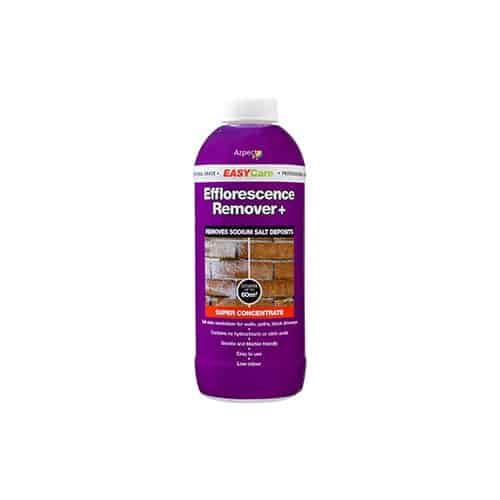
Azpects Easy Care Efflorescence Remover 1L
£22.95 ex. VAT
£27.54 inc. VAT
View ProductAdd To Basket
Sika Brick And Patio Cleaner 5L
£5.44 ex. VAT
£6.53 inc. VAT
View ProductAdd To Basket
Azpects Easy Care Efflorescence Remover 1L
£22.95 ex. VAT
£27.54 inc. VAT
View ProductAdd To BasketSika Brick And Patio Cleaner 5L
£5.44 ex. VAT
£6.53 inc. VAT
View ProductAdd To Basket